Industry Insight
Southeast Asia's AI Data Center Outlook for 2027: How Power Grids and Chip Controls Are Reshaping Malaysia and Indonesia
· By Liahnson & Company
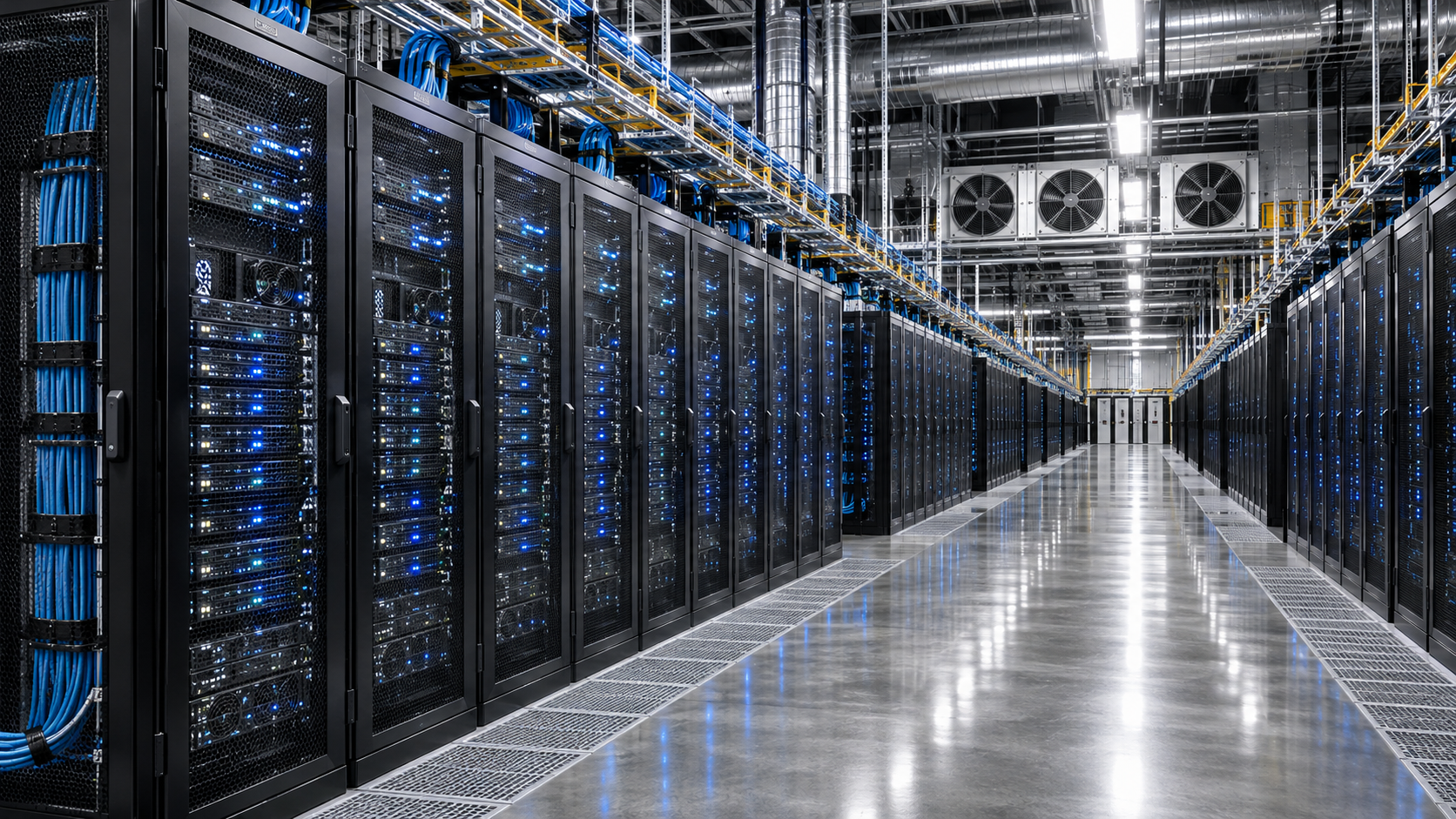
Every time you ask ChatGPT a question or stream a YouTube video, the computing doesn't happen on your phone. It happens inside a massive building somewhere, filled with tens of thousands of servers running around the clock. That building is a data center. As AI gets smarter, the world needs more of them and bigger ones, and Big Tech is now racing to find places to build. But the scarcest resource in this race isn't land or capital. It's electricity. A single large AI data center can draw as much power as a small city.
Nowhere is this power crunch playing out more dramatically than in Singapore and its neighbors. Short on electricity, Singapore released only 200MW of new data center capacity this year (1,000MW is roughly the output of one nuclear reactor). Meanwhile, just across the causeway in Johor, Malaysia, data center campuses of more than 1GW are going up, and on Indonesia's Batam Island, an hour away by ferry, large AI data center projects keep being announced. Rather than keep competing for the same investment, the three countries have started talking about dividing up power, land and roles. Here's what this three-way alliance looks like and where it stands today.
Why power, not land, now decides the AI data center race
Data centers have always been power-hungry, but AI has changed the math. The GPUs used to train and run AI models get hotter the more they compute. Pack them densely into server racks and the same floor space now consumes several times more electricity than a traditional data center, and AI training runs 24 hours a day. More power means more heat, and cooling that heat takes still more electricity and water. By some estimates, a large data center uses as much water in a day as a town of 50,000 people.
The US and Europe hit the wall first. In parts of the US, connecting a new data center to the grid can take more than a decade, and lead times for a single large transformer can stretch to four years. With traditional hubs constrained, investors went looking elsewhere, and Southeast Asia has emerged as the region to watch. According to energy think tank Ember, Indonesia, Malaysia, Singapore, Thailand, Vietnam and the Philippines already host more than 2,000 operating data centers, and data center investment in the region is expected to reach US$30 billion by 2030.
There's a catch. Southeast Asia is hot and humid all year, which means more electricity and water go into cooling. So in this region, the winners aren't the places with the cheapest land. They're the places that can deliver reliable power and water, ideally with a low carbon footprint.
Why three neighbors chose cooperation over competition
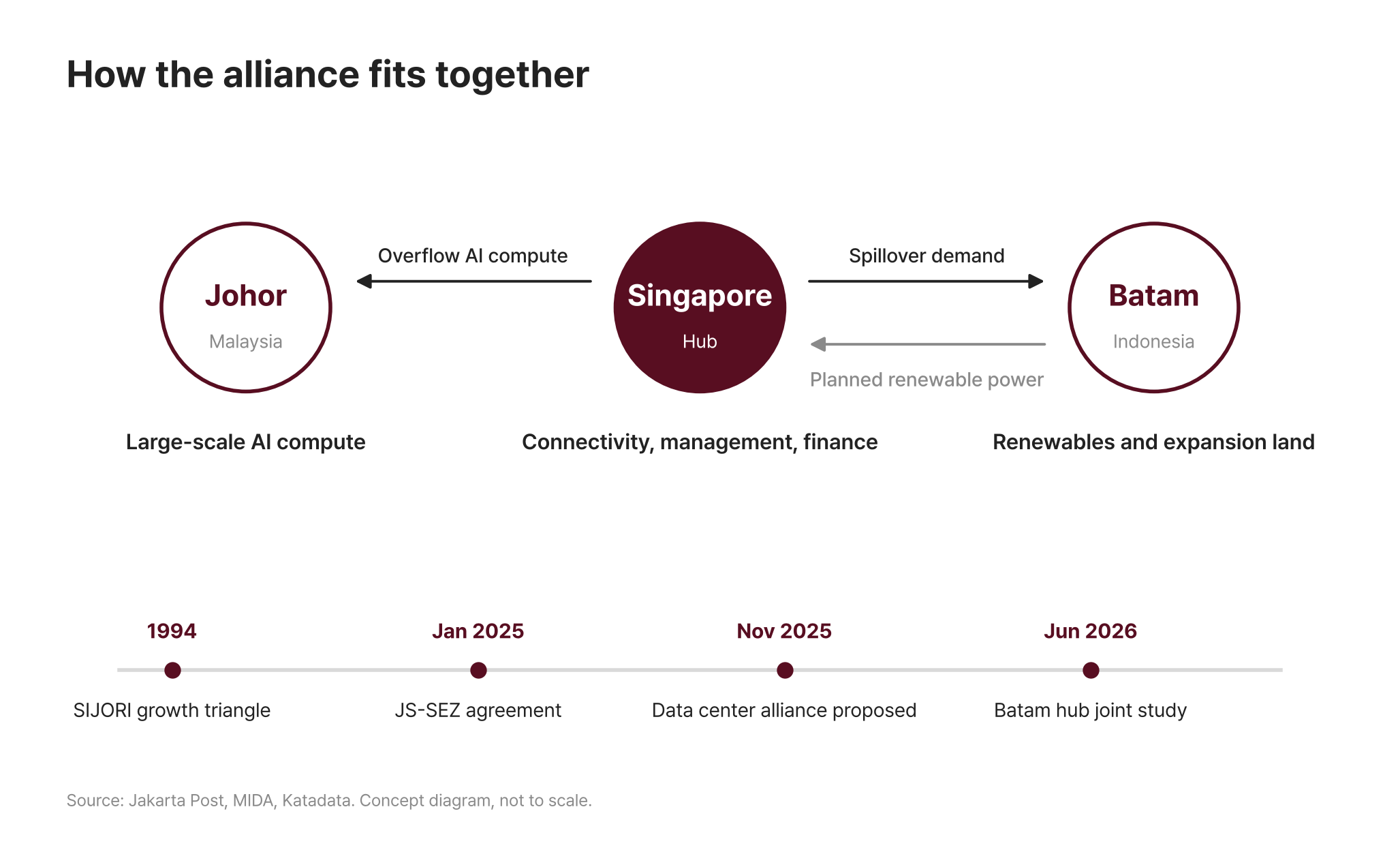
The idea first surfaced in November 2025, when Indonesia's Coordinating Minister for Economic Affairs Airlangga Hartarto said the country was discussing data center cooperation with Singapore and Malaysia. The stage is Singapore, Johor just to its north and Indonesia's Batam and Bintan islands just to its south. On a map, they form a tight cluster with Singapore in the middle.
Indonesia's pitch goes like this. State utility PLN is building the Green Super Grid, a transmission network linking renewable power plants across the archipelago, and Indonesia wants that power to feed data centers in the region. Because data centers buy large volumes of electricity over long periods, they also make ideal anchor customers for new renewable projects.
Proximity has a long history here. In 1994, Singapore, Johor and Indonesia's Riau province were linked as the SIJORI growth triangle. In January 2025, Malaysia and Singapore signed the Johor-Singapore Special Economic Zone (JS-SEZ) agreement. And in June 2026, Indonesia and Singapore agreed on a joint study to develop Batam, Bintan and Karimun as a data center hub.
What makes cooperation work is that each country's strengths fill the others' gaps.
Singapore | Malaysia (Johor) | Indonesia (Batam and Jakarta) | |
|---|---|---|---|
Role | Connectivity, management and finance hub | Large-scale AI compute | Market, renewables and expansion land |
Strengths | Subsea internet cables, Big Tech regional HQs, trusted regulation | Ample land, fast construction, proximity to Singapore, tax incentives | 280 million people, renewable resources, Batam's proximity to Singapore |
Gaps | Land, power and water; caps on new capacity | Rapidly rising power and water demand; local pushback | Transmission, slow permitting, shifting regulation |
Current capacity | 1.4GW+ | ~1.3GW | ~0.46–0.58GW |
Singapore is small, and land, power and water are always tight. From 2019 to 2022, it effectively halted new data center construction altogether. Today it is handing heavy compute to its neighbors and focusing on its role as the region's command center for managing and connecting data. As the landing point for subsea cables linking Asia, the Americas and Europe, it still has an edge nobody can easily replicate.
Johor has absorbed Singapore's overflow faster than anywhere else. Close to Singapore but with plenty of land and fast build times, it has helped push Malaysia past 500 operating data centers, with more than 300 under construction.
Indonesia is still small in data center terms, but it has the region's largest population and abundant renewable resources. Its current capacity of around 0.5GW is less than half that of Singapore or Malaysia, yet about 1.3GW of investment is in the pipeline. Batam in particular is already connected to 13 international cable systems and is positioning itself to catch Singapore's spillover demand. For Indonesia, the alliance is a way to win a share of the investment that would otherwise flow to Johor.
The Green Super Grid and the challenge of cross-border power
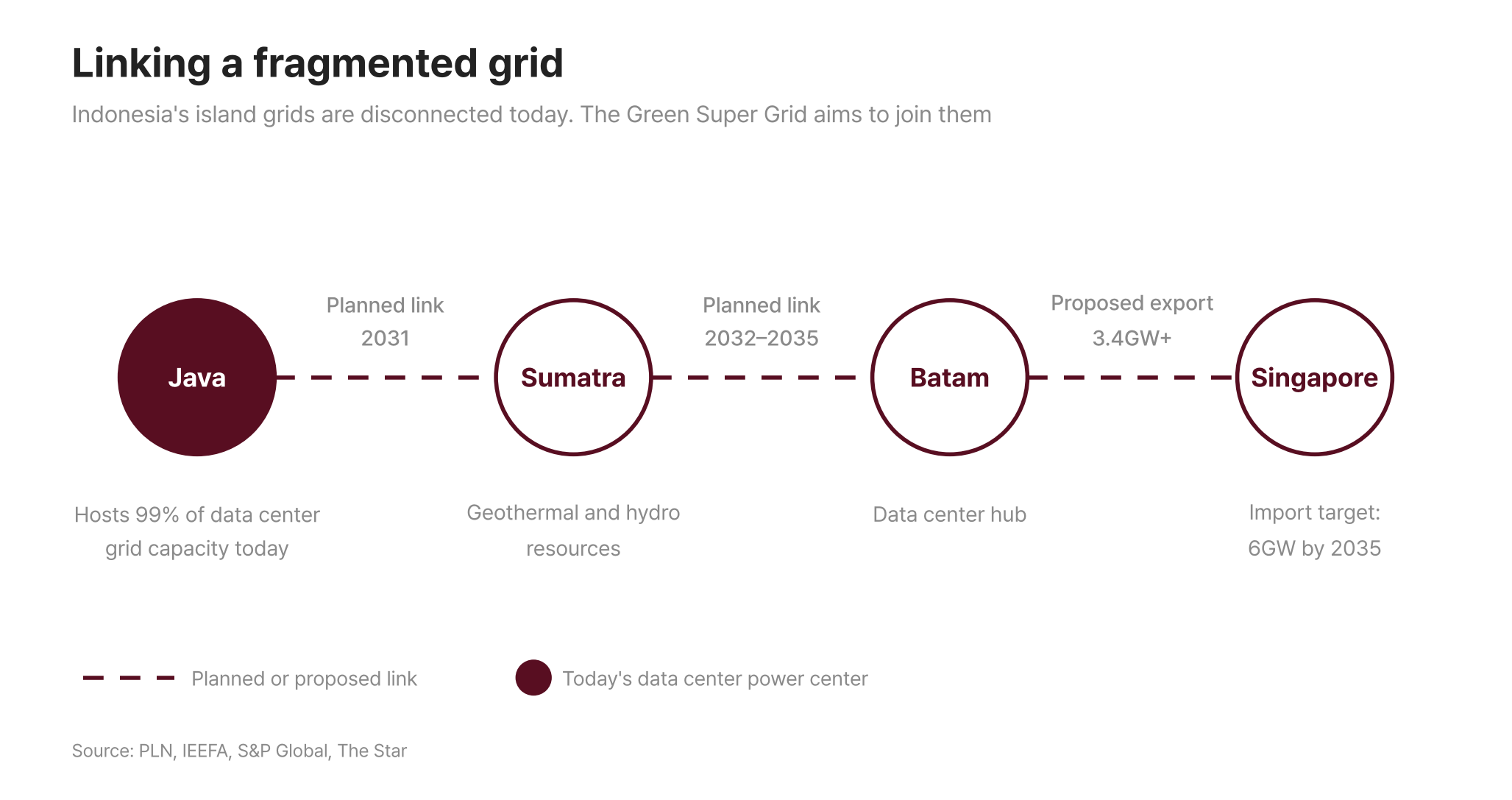
Indonesia is made up of more than 17,000 islands, and its power grid is just as fragmented. Sumatra may have plenty of geothermal plants, but without transmission lines to Java or Batam, that power stays stranded. The Green Super Grid aims to stitch these island grids together with subsea and long-distance transmission lines, moving hydro, geothermal and solar power to where it's needed. By scale, it's the most ambitious renewable energy plan in Southeast Asia.
Investment: about US$25 billion (PLN estimate)
10-year target: 69.5GW of new generation and storage by 2034, including 42.6GW of renewables
Key link: an ultra-high-voltage line connecting Sumatra and Java, targeted for 2031
Additional plan: a 100GW solar program to be completed by 2029 (announced in August 2026)
The problem is speed. According to IEEFA, PLN built only 26% of its 2025 transmission target. Inter-island links reaching the Riau Islands, where Batam sits, aren't scheduled until 2032 to 2035, and the full Green Super Grid won't be complete until 2040. Today, Indonesia's data centers draw power almost entirely from Java, home to the capital Jakarta, with 99% of PLN's connected data center capacity sitting on the Java-Madura-Bali grid. The ambition is real, but clean power reaching Batam's data centers is still years away.
Cross-border electricity trade has long been on ASEAN's agenda. The bloc aims to connect its members' grids by 2045, and a project sending Laotian hydropower through Thailand and Malaysia to Singapore has already shown it can work. Singapore, short on power, has set a target of importing 6GW of low-carbon electricity by 2035, with more than 3.4GW of that planned from Indonesia.
In November, that plan hit a snag. Indonesia's state news agency Antara reported that Energy and Mineral Resources Minister Bahlil Lahadalia, speaking at a mining and coal convention in Jakarta on November 2, said "Indonesia will not be able to export electricity in the near future." He added that Indonesia still needs the power itself and will put domestic demand first unless the price is right. The takeaway is that Indonesia sees renewable power less as an export commodity and more as a tool for attracting investment. Getting data centers built on Indonesian soil brings jobs and tax revenue that exporting electrons to Singapore does not. Singapore, on the other hand, needs imported power to run its data centers and meet its decarbonization targets. Even within the alliance, the two sides don't agree on where the electricity should go, which is why Singapore has recently approved 900MW of imports from Malaysia and another 1.3GW import project to diversify its supply.
Laying transmission lines doesn't automatically make a data center green, either. Solar only works when the sun is up and wind only when it blows, but AI runs day and night. Running a data center on renewables takes several pieces working together.
Power purchase agreements (PPAs): long-term contracts, often 10 to 20 years, to buy electricity from a generator at a fixed price. They make costs predictable even when power prices swing, which is why they underpin data center economics.
Energy storage systems (ESS): large batteries that store surplus daytime solar power for use at night.
Weather-independent low-carbon power: sources like hydro and geothermal that generate steadily regardless of the weather.
Tracking and verification: systems that record which power was used and when. Customers like Google and Microsoft rely on these records to report progress on their carbon targets.

Where Big Tech is putting its money
The biggest reason this alliance matters is that money is actually flowing in. Google, Microsoft, Amazon and specialist data center operators kept investing heavily across all three markets in 2026, though the shape of that investment differs by country.
Malaysia, the region's biggest magnet for capital
Malaysia approved about US$30.2 billion in data center and cloud investment in the first nine months of 2026, up 44.5% year on year. On November 4, Google announced plans to invest US$15 billion in new data center campuses in Malaysia over 2027 and 2028, more than seven times its earlier US$2 billion commitment. Microsoft has also committed US$2.2 billion over four years. In Johor, local group YTL Power is building a 1.2GW campus with the first 300MW due online in early 2027, while Singapore-based DayOne already operates more than 478MW there.
Singapore, exporting compute but keeping the headquarters
Despite its land and power constraints, Singapore remains Big Tech's regional headquarters. Amazon Web Services (AWS) plans to invest S$12 billion in Singapore's cloud infrastructure through 2028, and Microsoft announced an additional US$5.5 billion in early 2026. Heavy AI compute may move to Johor, but the core functions of managing and connecting data are staying in Singapore.
Indonesia, catching up with Batam in the lead
Indonesia is still smaller but closing the gap quickly. Microsoft opened a local cloud data center region as part of a US$1.7 billion investment, its largest in 29 years in the country, and Oracle launched a cloud region in Batam in 2025. Australia's Firmus announced plans in June 2026 for a 360MW AI data center in Batam powered by Nvidia chips. Still, Jakarta remains the center of Indonesia's data center market, and most analysts see Batam as a satellite hub tied to Singapore. It's also worth noting how dependent the market is on foreign players. Local operators account for only about 10% of Indonesia's live data center capacity.
Investment that crosses borders
The way capital moves is changing too. SoftBank's Singapore subsidiary has teamed up with Singaporean and Malaysian partners to build AI data centers across Malaysia, Thailand, Indonesia and Vietnam. In M&A, data center platforms with land and power secured in multiple countries are changing hands at 25 to 35 times annual earnings (EBITDA). Put simply, a company earning US$10 million a year would sell for US$250 million to US$350 million, a sign of how scarce power-ready sites have become. Global investors are starting to treat Southeast Asia as one investment map rather than a set of individual markets.
From attracting to selecting: how policy differs by country
All three countries want data center investment, but they're welcoming it in different ways. What they share is that they no longer say yes to everything. With power and water limited, they are increasingly choosing which projects to accept.
Singapore | Malaysia | Indonesia | |
|---|---|---|---|
Approach | Fixed capacity allocations, efficient facilities only | Selective, with a focus on AI data centers | Active promotion through special economic zones |
Tax incentives | 17% standard corporate tax rate | 5% corporate tax for up to 15 years for new AI and other high-tech investment in the JS-SEZ | Up to 20 years of corporate tax exemption and import duty exemptions in special economic zones |
Recent restrictions | 200MW of new capacity in 2026, strict efficiency standards | No new applications for non-AI data centers; decisions on 24 new applications deferred | Transmission gaps; uncertainty over incentives outside special zones |
Foreign ownership | Open | Open | No limits; 100% foreign ownership allowed in special zones |
Singapore: limited allocations and strict standards
Singapore is releasing new capacity in small increments with demanding conditions attached. In the application round that closed in March 2026, it offered just 200MW and required a PUE below 1.25. PUE (power usage effectiveness) measures how much of a data center's total power goes to things other than the servers themselves, such as cooling. The closer to 1, the less waste. The message is clear. Heavy compute can go next door, while Singapore keeps only highly efficient, high-value facilities.
Malaysia: choosing quality over quantity
Malaysia welcomed investment more aggressively than anyone, but it is now tapping the brakes. Since February 2026, it has stopped accepting applications for data centers not tied to AI, and in October it deferred decisions on 24 new applications while it assesses whether power and water supply can keep up. At the same time, it plans to add gas-fired capacity and aims to bring its first nuclear plant online by 2031. In the JS-SEZ, new investment in AI and other advanced sectors qualifies for a 5% corporate tax rate, a significant break compared with Malaysia's standard 24%.
Indonesia: wide open doors, missing infrastructure
Indonesia is the easiest of the three to enter. There are no foreign ownership limits on data center businesses, and companies in special economic zones can go up to 20 years without paying corporate tax. But no tax break can run a data center without power. That's why research firm BMI argues incentives alone can't make up for the infrastructure gap.
Four obstacles to green AI data centers
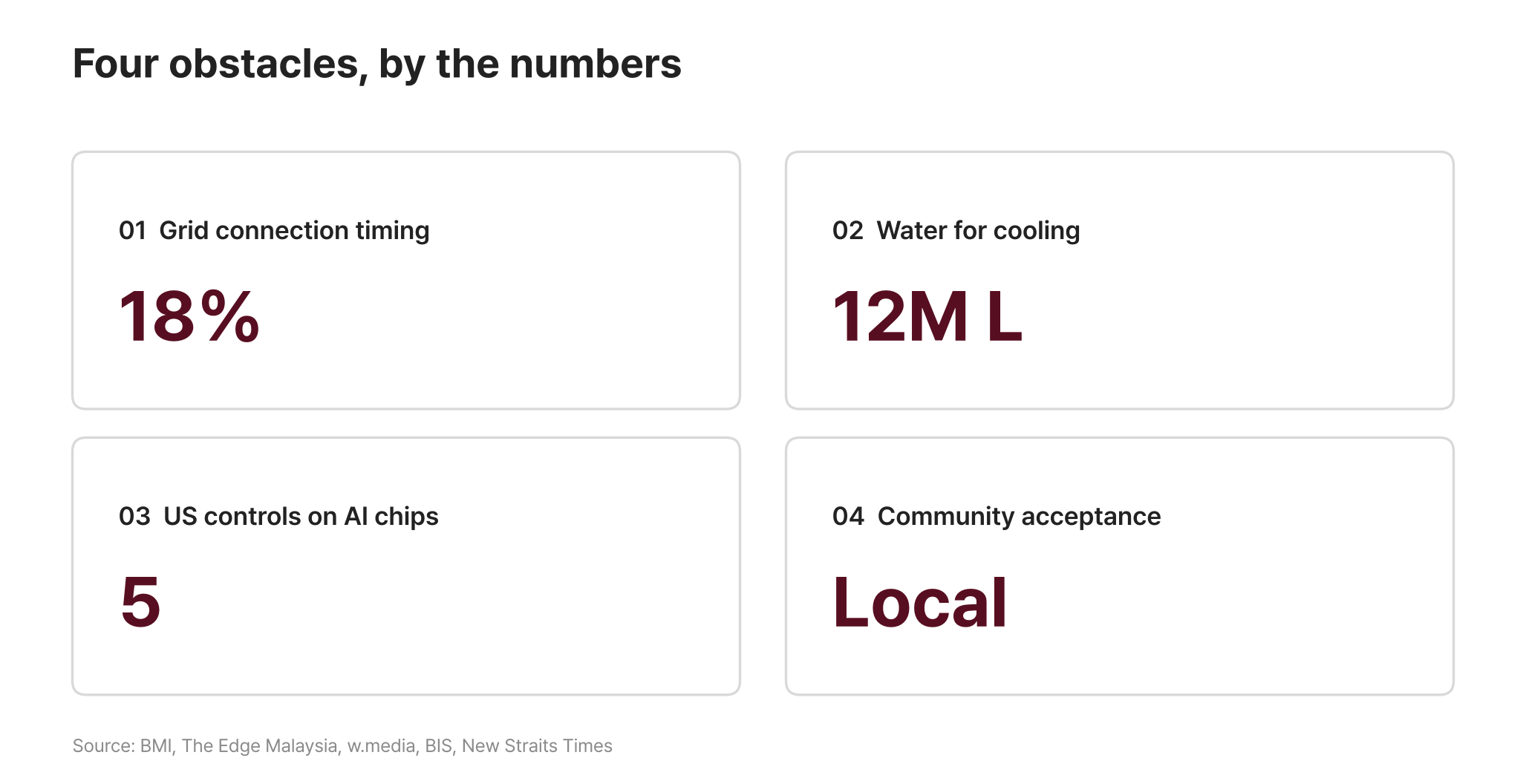
Data center headlines are full of big numbers, gigawatts here and billions of dollars there. What really matters, though, isn't the announcement. It's when a facility actually comes online and at what scale. Four obstacles deserve close attention in this region.
1. Grid connection timing
BMI projects that by 2031, Johor's data centers could consume 18% of all electricity in Peninsular Malaysia, triple the 6% share in 2026. That would mean data centers absorbing more than 90% of the peninsula's new generation. BMI notes that the bigger problem isn't building power plants but connecting data centers to the grid.
2. Securing water for cooling
Johor has banned lower-tier data centers that use large amounts of water. Operators are turning to treated wastewater and filtered river water, and one local sewerage operator now supplies 12 million liters of recycled water a day to data centers. Water scarcity is also emerging as a concern in Batam.
3. US controls on AI chips
The US already bars sales of the most advanced AI chips, such as those made by Nvidia, to China. But Chinese companies have worked around this by renting chips housed in data centers in Singapore or Malaysia over the internet rather than buying them outright. To close that gap, the US Commerce Department's Bureau of Industry and Security (BIS) released a new rule on November 16, 2026. In its press release, BIS said the rule ensures existing restrictions "cannot be circumvented through remote computing arrangements involving data centers in third countries." Its key provisions are as follows.
Designated licensing countries: shipping advanced AI chips to Indonesia, Malaysia, Singapore, Thailand or Brazil now requires a US government license. The rule describes these five countries as presenting "a higher-than-normal risk of diversion."
Exclusion for US companies: chips shipped to US-headquartered companies are exempt from licensing, provided the companies report monthly on where and to whom the chips went.
Limits on remote access: data centers that rent AI computing capacity to Chinese companies need a separate license, wherever they are located.
Singapore responded quickly. According to Al Jazeera, Singapore's Ministry of Trade and Industry and Ministry of Digital Development and Information said in a joint statement that they were engaging affected companies and US authorities, and "exploring how to facilitate trusted access for Singapore companies." The statement shows that a data center's competitiveness in Southeast Asia is no longer decided by power and land alone. No matter how many facilities a country builds, they can't do their job without the latest AI chips. Going forward, whether a data center serves customers the US considers trustworthy could become a key factor in its value.
4. Community acceptance
In Johor, local media have reported growing resident pushback over transmission towers, noise and forest clearing near data centers, along with concerns about falling property values. These tensions could lead to permitting delays or new regulations.
None of these risks is easy to spot from press releases or corporate announcements. Whether a site actually has its power allocation, whether substation construction is on schedule, how local governments and residents feel about a project are things the people working on the ground know best.
Signals investors and companies should watch
The questions companies need to ask before building in Southeast Asia are changing. It used to be about which country to choose. Now it's about what kind of power you can secure, for how long and at what price. That's why a multi-country approach is emerging as a practical option, with latency-sensitive services in Singapore, large-scale AI compute in Johor, and Indonesian market access and long-term renewable supply in Batam and Jakarta.
Investors need to look at different numbers too. Rather than announced investment or headline capacity, what determines a project's real value is whether it has a long-term power contract, whether its grid connection date is locked in and whether it can import the latest AI chips. Over the next six to twelve months, these are the developments to watch.
Whether Indonesia and Singapore agree on an export price, and when power actually starts flowing
How much of Batam's planned capacity actually comes online
When and on what terms Malaysia resumes processing deferred applications
How quickly US AI chip export licenses are granted, and to whom
Whether Green Super Grid projects such as the Sumatra-Java link stay on schedule
Indonesia's data center industry believes the next two to three years will decide whether the country can become a regional data center hub. Once Big Tech companies like Google or Microsoft commit to Johor or Singapore, suppliers and infrastructure follow, and that momentum is hard to reverse.
Conclusion: in this market, clean power wins
The winners of Southeast Asia's AI data center race likely won't be the countries that build the most facilities, but the ones that can supply clean power reliably and trade it across borders. And the outcome will show up first not in investment announcements, but on the ground, where power is flowing and servers are running.
The bigger and faster a market moves, the wider the gap between what's in the news and what's happening on site. Liahnson & Company helps close that gap through interviews with experts from local utilities, data center operators, construction firms and government policy roles. If you're exploring data center investment or market entry in Southeast Asia and want to hear directly from people on the ground, get in touch with Liahnson & Company. We'll find and connect you with the right experts.

Source
Jakarta Post, RI looks to partner with Malaysia, Singapore for cross-border data center (2025.11.21): https://www.thejakartapost.com/business/2025/11/21/ri-looks-to-partner-with-malaysia-singapore-for-cross-border-data-center.html
Katadata, Malaysia-Singapura Tancap Gas Bangun Hub AI, Indonesia Berisiko Jadi Pasar (2026.7.16): https://katadata.co.id/amp/indepth/telaah/6a57ad091e4d5/malaysia-singapura-tancap-gas-bangun-hub-ai-indonesia-berisiko-jadi-pasar
IEEFA, Indonesia's electricity planning framework needs single transparent benchmark: https://ieefa.org/resources/indonesias-electricity-planning-framework-needs-single-transparent-benchmark
S&P Global, Indonesia maps grid strategy for hyperscale data center boom (2026.9.22): https://www.spglobal.com/energy/en/news-research/latest-news/energy-transition/092226-indonesia-maps-grid-strategy-for-hyperscale-data-center-boom
Antara, Minister says electricity exports remain off Indonesia's agenda (2026.11.2): https://en.antaranews.com/news/439547/minister-says-electricity-exports-remain-off-indonesias-agenda
EMA, Conditional Approval for 900MW of Electricity Trade Between Peninsular Malaysia and Singapore (2026.8.7): https://www.ema.gov.sg/content/dam/corporate/news/media-releases/2026/20260807-Media-Release-Conditional-Approval-for-900MW-of-Electricity-Trade-Between-Peninsular%20Malaysia-SG.pdf.coredownload.pdf
MIDA, Johor-Singapore SEZ new incentive package: https://www.mida.gov.my/mida-news/johor-singapore-sez-new-incentive-package-to-attract-high-value-investments/
The Edge Malaysia, Johor data centres could consume over 90% of peninsula's additional power generation by 2031 – BMI (2026.10.23): https://theedgemalaysia.com/node/822977
BIS, BIS Issues Rule Addressing Remote Access to American Super Intelligence Technology (2026.11.16): https://www.bis.gov/press-release/bis-issues-rule-addressing-remote-access-american-super-intelligence-technology
Al Jazeera, US moves to block China's remote access to AI chips (2026.11.17): https://www.aljazeera.com/economy/2026/11/17/us-moves-to-block-chinas-remote-access-to-ai-chips-amid-nvidia-scandal